
Why should we be careful with AI and image generation?
)
Hello, fellow teachers! Have you noticed how artificial intelligence (AI) is becoming more and more a part of our daily lives? It’s like having a genie in a lamp—but instead of granting wishes, it creates images! But wait a minute—not everything is rosy in the world of AI. We need to stay alert so we don’t fall into any traps.
I asked an AI to draw me in a diverse classroom. I gave all the instructions correctly in the prompt. This is the drawing it produced!
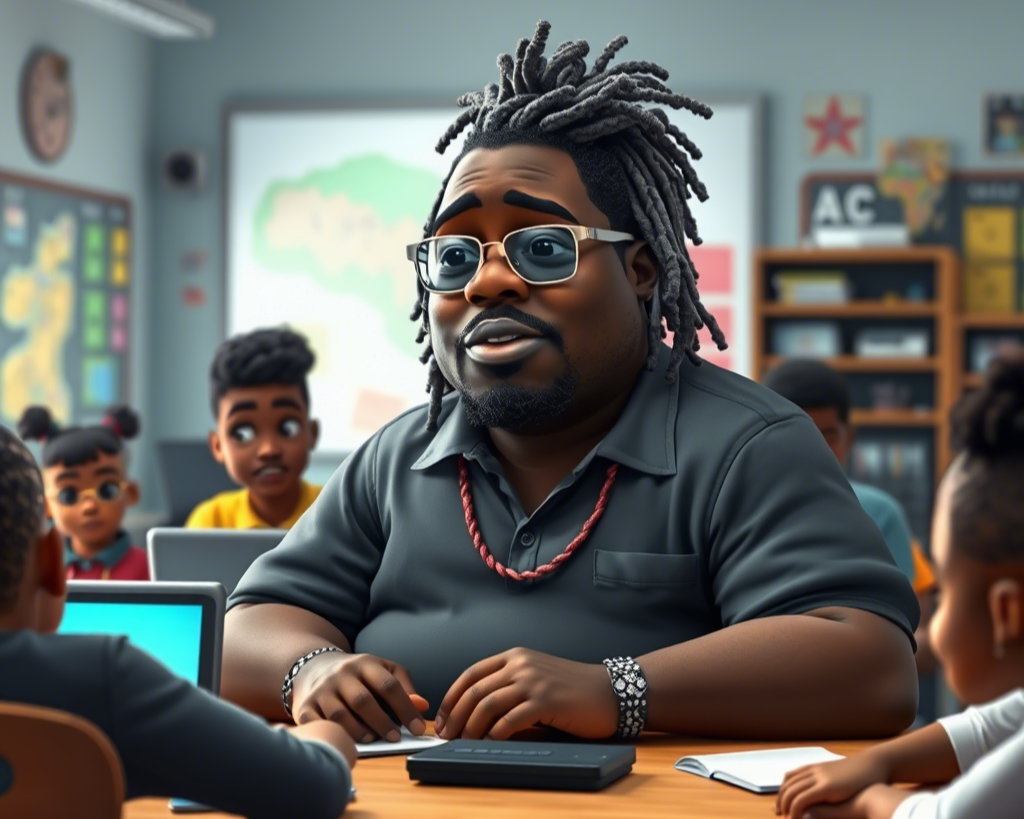
Although the AI created a nice illustration, it portrays a false sense of diversity. Does a classroom with a Black teacher have to have only Black students? The illustration is beautiful, but it doesn’t reflect (at all) my classroom, which is filled with people of all colors and shapes—both typical and atypical. It’s a beautiful illustration, but these images perpetuate cultural apartheid. Be careful not to fall for this idea.
The Dark Side of AI Images: Biases and Stereotypes
You know that saying, “garbage in, garbage out”? It really applies to AI! If the data used to train the AI is biased, the images it creates will be too. And that’s where the danger lies!
- Reinforced stereotypes: Imagine you ask the AI to generate an image of a “teacher.” If the AI’s database only contains photos of middle-aged white men, that’s what it will give you. This reinforces the stereotype that only white men are teachers and excludes the diversity of professionals we have in our schools.
- Racial and gender biases: the issue becomes even more serious when we talk about race and gender. A study showed that when an AI is asked to generate images of people in professions such as doctors and lawyers, the images are usually of white men. However, when the request is for images of nurses, the majority of the images are of women. This reinforces gender stereotypes, demonstrating how AI can perpetuate biases.
- Algorithmic racism: we must not forget about algorithmic racism. An MIT researcher discovered that AI systems had difficulty recognizing Black faces as human. When she wore a white mask, the AI recognized her. This is a very serious issue and demonstrates that AI can reproduce the biases that exist in society. Another alarming case involved Google Photos, which, in 2015, classified Black people as gorillas.
- A vicious cycle: AI is trained using images, and then it generates new images; so if the training image dataset has a bias, it will reinforce that bias, creating even more biased images that will be used to train other AI systems. It’s a self-reinforcing cycle.
Real and alarming data
To show that we're not talking about imaginary things, let's look at the data:
- Arrests Based on Facial Recognition: In Brazil, in 2019, 90% of the people arrested through facial recognition were Black. An innocent Black woman was arrested because the AI mistook her for someone else. This shows how AI can be used unfairly and reinforce racism.
- Midjourney and gender stereotypes: An analysis of more than 5,000 images created by the AI Midjourney showed that when images of people in professions such as doctors or lawyers were requested, the images were generally of men. In contrast, images of nurses and teachers were always of women.
See also:
- (Self-)Teacher Training: Growing in 2025—Go Wherever You Want!
- The Rise of Generation Beta: A Lighthearted Analysis of the Digitally Immersed
- Agentic AI: The Next Step in AI
How can you avoid making that mistake?
Relax, teachers! AI isn't rocket science. We can use it thoughtfully and responsibly. Here are a few tips:
- A Critical Eye: When using AI-generated images, ask yourself: Does this image reinforce any stereotypes? Does it represent the world’s diversity? If the answer is no, look for other options.
- Data diversity: It is essential that AI databases be diverse and represent all people, races, genders, and ages. This will enable AI to create more inclusive images.
- Inclusion in development: It is important for diverse teams to participate in the development of AI. This allows us to identify and correct biases before they become a reality.
- Anti-racist education: Above all else , education is the key to combating prejudice. Students must learn to ask questions, critically analyze information, and build a more just and equitable society.
- Transparency and evaluation: AI systems must be transparent, allowing everyone to understand how they work and make decisions. The performance of these systems must be continuously evaluated to identify and correct potential biases.
Creative Lesson: Exploring Images Critically and Reflectively
Objective: To teach elementary school students how to interpret and create images that challenge stereotypes and promote diversity.
3-Step Lesson Plan:
Initial discussion:
- Show some simple images and ask, "What do they tell us? Is there any bias here?"
- Encourage students to reflect on how images can convey implicit messages.
Hands-on activity:
- In groups, analyze images cut out of magazines.
- Each student creates their own image or collage that expresses diversity, happiness, or overcoming adversity.
Final share:
- Ask the students to present their creations and explain their choices.
- Emphasize the importance of creating inclusive and fair narratives
Expected result:
Develop critical and creative skills to interpret and produce images that challenge prejudices and inspire change.
Let's talk! How would you address issues like racism, misogyny, or ageism in the classroom? Share your ideas!
Without fear, with awareness
AI is a powerful tool that can be of great help to us, but we must use it with care. By being aware of the dangers of biases and stereotypes, we can create a more just and inclusive world, where technology is an ally rather than a villain.
About the author:
)
*This text does not necessarily reflect the opinion of Bett Brasil.
Share on social media:
Categories
- Innovation