
Cell phone use in the classroom is the focus of the Bett Meeting, a “preview” of Bett Brasil 2024
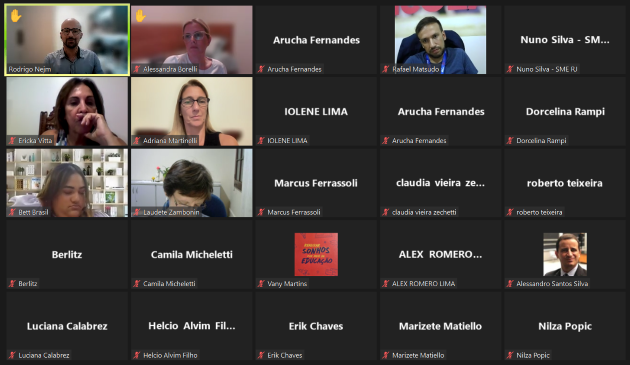
There’s just one month left until the largest Innovation and Technology for Education event in Latin America. To ease the anticipation of bringing the educational community together at the 29th edition of Bett Brasil, the Bett Meeting | Administrators’ Forum discussed the topic “Managing Human Relations in Education in the Technological Age: Connectivity in the School Environment” on Wednesday (20), with the aim of addressing an issue that is sure to spark many conversations and reflections during the event: the use of cell phones and other mobile devices in schools—should they be banned or not? The online meeting was attended by leaders and administrators from the country’s public and private K-12 education sectors.
“It’s anything but a formal lecture. The Bett Meeting is designed to be a casual conversation aimed at providing relevant content and fostering relationships based on that content. This initiative also serves as a ‘warm-up’ for Bett Brasil, with the goal of continuing this dialogue there,” said Adriana Martinelli, Director of Content at Bett Brasil, as she opened the online conversation with all participants via Zoom.
To explore this topic, the Bett Meeting featured lawyer Alessandra Borelli, who specializes in digital law, and Rodrigo Nejm, who holds a Ph.D. in psychology and is a specialist in digital culture. Alessandra noted that we are living in a paradoxical reality today, in which technology continues to advance without turning back, and at the same time, from a mental health perspective, we are becoming increasingly aware of the issue and are “losing control” over our use of technology.
“If, before the pandemic, we had managed to make progress in directing technological resources toward a more productive, more mindful, and healthier use, today we have regressed in every area where we had advanced; therefore, there is this great concern about our mental health. On the other hand, new technologies, when used properly, are excellent tools—including from an educational standpoint,” said Alessandra.
Read more:
- With new features, the Managers' Forum offers essential discussions on school management in basic education
- "The lecture-style class is dead for the vast majority of students. We need to redesign the learning process without the lecture," says Silvio Meira
- Adriana Martinelli discusses the content curation process and offers a preview of what to expect from the 29th edition of Bett Brasil
The attorney explained that, for technology to be used in an ethical, legal, productive, safe, healthy, and mindful way, certain measures must be taken beyond legal parameters. The use of technological resources in the educational approach must be strategically aligned to ensure it is used in the best possible way. “Anyone who believes we need a law to set the rules of the game will be waiting in vain, because no law is capable of changing behavior,” said Alessandra.
She also said that we need to establish clear rules for cell phone use, accompanied by disciplinary measures that are effectively enforced whenever necessary and that demonstrate the schools’ commitment to the issue. “This requires ongoing awareness-raising efforts, with a collaborative approach driven by actively listening to students so that they, too, can participate in this process,” emphasized the expert in digital law.
Rodrigo took the opportunity to discuss the intentionality of use and the different ways students engage with digital devices. “When we look specifically at students using digital technologies within the school, pedagogical intentionality must be the primary criterion for evaluating any and all strategies used to engage with technology. However, students also spend many hours outside of school, hyperconnected,” commented the psychologist.
He illustrated the idea using the concept of resilience, which is used in psychology and is based on a principle in physics regarding a material's ability to return to its original shape after being subjected to a strong impact.
“What kind of digital resilience can we help our students develop so that they have the insight to recognize that a risky situation can lead to harm, yet not every risk necessarily causes harm—depending on their ability to handle the situation? Similarly, as education leaders, we must recognize that not every opportunity presented by digital technology will result in a benefit. It also depends on the ability—as individuals, professionals, and institutions—to ensure that the intentional use of technology in the classroom can be an opportunity transformed into benefits for the learning process, thereby broadening students’ civic awareness, and so on,” said Nejm.
At the end of the meeting, Adriana added: “There’s no ready-made solution. Our role is to analyze the situation and seek solutions that are more or less appropriate. As Silvio Meira explained—in a talk last year at Bett Brasil—we’re facing complex issues today that can no longer be answered with a simple ‘yes’ or ‘no,’ ‘right’ or ‘wrong.’”
The discussion will be expanded upon and explored in greater depth at Bett Brasil, which will take place April 23–26 at Expo Center Norte in São Paulo. To discuss the use of technology in schools, confirmed speakers include Patrícia Blanco, CEO of Instituto Palavra Aberta; Renan Ferreirinha, Secretary of Education for the City of Rio de Janeiro; Emerson Bento Pereira, Director of Educational Technology at Colégio Bandeirantes; and Alessandra Borelli, an expert in digital law, among others. Check out the full schedule here.
To register for Bett Brasil, click here. Admission is free.
Share on social media:
Categories
- The Future of Education
- Educational Management